
Renewable energy business in oil companies - Case studies in Japan
Abstract
Renewable energy has been the top preference among new business domains of Japanese oil companies. Applying qualitative research method, the paper aims to analyse the practices of renewable energy projects in these companies, highlighting various influential factors on investment decisions in this field.
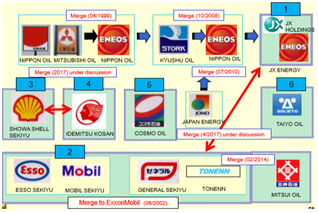
The fact is that five among seven Japanese oil companies choose at least one renewable energy sector as new business, including hydrogen stations, fuel cells, bio-fuel, biomass, solar energy, wind energy and geo-thermal. It is stakeholders concerned such as governmental agencies, consumers, users, suppliers, competitors, shareholders, investors, and employees that have impacts on a company’s policies toward renewable energy. Especially, in Japanese oil companies, the important internal motivation is business transformation into total energy companies. Besides, national policies are the catalyst for renewable energy investment in most of the cases.
However, in order to retain the business, profits are the crucial element which could be granted through feed-in tariff (FIT) mechanism. Over the time, FIT, an economic instrument of the government, would be reduced as renewables become more cost competitive with traditional energy sources. In turn, companies’ efforts to manage production cost and output quality as well as to enhance internal capacity or international co-operation would play a significant role in making renewable energy business become sustainable in the long run.
References
2. Tracey Strange, Anne Bayley. Sustainable development: Linking economy, society, environment. OECD insights. 2008.
3. Trish Sissons. Cause marketing and corporate social responsibility. www.sponsifi.com.
4. Agnieszka Żak. Triple bottom line concept in theory and practice. Research papers of Wroclaw University of Economics. 2015; 387: p. 251 - 264.
5. Roger Perman, Yue Ma, James McGilvray, Michael Common. Natural resource and Environmental economics (3rd edition). Pearson Education Limited. 2013.
6. Tom Tietenberg, Lynne Lewis. Environmental & natural resource economics (9th edition). Pearson Education Limited. 2011.
7. Bunsuke Kariya. Renewable energy in Japan. Japan Cooperation Center Petroleum. 2017.
8. US Department of Energy. Developing renewable energy projects larger than 10 MWs at federal facilities - A practical guide to getting large-scale renewable energy projects financed with private capital. Federal Energy Management Program. 2013.
9. Bunsuke Kariya. Oil industry in Japan. Japan Cooperation Center Petroleum. 2017.
10. CSR report. JXTG Nippon Oil and Energy Corporation. 2016.
11. Keiji Kimura. Feed-in tariffs in Japan: Five years of achievements and future challenges. Renewable Energy Institute. 2017.
12. www.idemitsu.com.
13. www.showa-shell.co.jp.
14. www.cosmo-oil.co.jp.
15. www.mitsui.com.
16. METI. Strategic energy plan. 2014.
17. DLA Piper. Renewable energy in the Asia Pacific (4th edition). 2017.
18. METI. Strategic roadmap for hydrogen and fuel cells. 2014.
19. METI. Long-term energy supply and demand outlook. 2015.
20. Japan Oil, Gas, Metals National Corporation. Current situation of geothermal power generation in Japan. 2016.
21. David Timmons, Jonathan M.Harris, Brian Roach. The economics of renewable energy: A GDAE teaching module on social and environmental issues in economics. Global Development and Environment Institute, Tufts University, Medford, MA. 2014.
22. Norikazu Hatta. Current status and issues of wind power business in Japan. Cosmo Energy Holdings, Japan Cooperation Center Petroleum JCCP. 2017.
1. The Author assigns all copyright in and to the article (the Work) to the Petrovietnam Journal, including the right to publish, republish, transmit, sell and distribute the Work in whole or in part in electronic and print editions of the Journal, in all media of expression now known or later developed.
2. By this assignment of copyright to the Petrovietnam Journal, reproduction, posting, transmission, distribution or other use of the Work in whole or in part in any medium by the Author requires a full citation to the Journal, suitable in form and content as follows: title of article, authors’ names, journal title, volume, issue, year, copyright owner as specified in the Journal, DOI number. Links to the final article published on the website of the Journal are encouraged.


